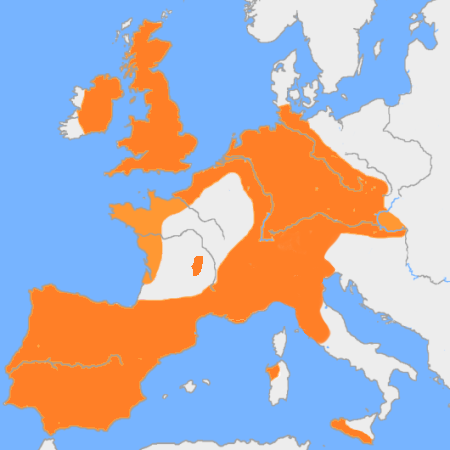
Par informacija o Bell Beaker kulturi zapadne Evrope i njenoj vezi sa R1b haplogrupom.
Opseg Bell Beaker kulture
Frekvencije R1b u Evropi
The Bell-Beaker culture (sometimes shortened to Beaker culture, Beaker people, or Beaker folk; German: Glockenbecherkultur), ca. 2400 – 1800 BC,[1] is the term for a widely scattered cultural phenomenon of prehistoric western Europe starting in the late Neolithic or Chalcolithic running into the early Bronze Age.
Until recently, early Bell Beakers of the All Over Ornamented (AOO) type were thought to have developed from Corded Ware ceramics of the northern parts of Central and Eastern Europe, such as the Protruding Foot Beaker (PFB), a type of late Neolithic (2850-2450 BC) vessel found in the Netherlands and lower Rhine Valley, that were typically ornamented with cord impressed decoration mixed with comb impressions and herringbone-style incisions.[5]
However Bell Beakers have now been radiocarbon dated to 2900 to 1800/1700 BC, which would make them contemporary with Corded Ware.
However a recent overview of all available sources from southern Germany concluded
that the Bell Beaker Culture was a new and independent culture in that area, contemporary with the Corded Ware Culture.[10] This conclusion was supported by a review of radiocarbon dates for Bell Beaker across Europe, which showed that the
earliest dates for Bell Beaker were 2900 BC in Iberia . This makes the style contemporary with Corded Ware, but beginning in a different region of Europe
Bell Beaker has been suggested as a candidate for an early Indo-European culture, more specifically,
an ancestral proto-Celtic [9] or proto-Italic or Italo-Celtic culture.
Historical craniometric studies found that the
Beaker people appeared to be of a different physical type than those earlier populations in the same geographic areas. They were described as tall, heavy boned and brachycephalic.
Ukratko, Bell Beaker je došla na zapad Evrope otprilike u isto vrijeme kad i R1a(Corded Ware) na istok. Po svoj prilici, oko 3000 BC je već bila na jugu Španije i sva je prilika da je tamo dospjela iz sjeverne Afrike (prisustvo R1b u sjevernoj Africi), a dalje iz Anadolije, a da se zatim iz Iberije širila po cijeloj zapadnoj Evropi. Predak je italo-keltskih jezika. U fizičkom smislu bili su drugačiji od starosjedilačkog stanovništva koje su uspješno potiskivali i gotovo potamanili. Bila im je poznata prerada metala, moreplovstvo, poljoprivreda.