Negde sam naišao na podatak da je ta osobina (riđa kosa) u nekoj meri povezana sa sklapanjem brakova u visokom stepenu krvnog srodstva.
Biochemistry and genetics
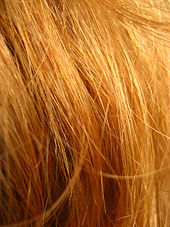
A close-up view of red hair
The pigment
pheomelanin gives red hair its distinctive color. Red hair has far more of the pigment pheomelanin than it has of the dark pigment eumelanin.
The
genetics of red hair, discovered in 1997, appear to be associated with the
melanocortin-1 receptor (MC1R), which is found on
chromosome 16. Red hair is associated with fair skin color because low concentrations of eumelanin throughout the body of those with red hair caused by a MC1R mutation can cause both. The lower melanin concentration in skin confers the advantage that a sufficient concentration of important
Vitamin D can be produced under low light conditions. However, when UV-radiation is strong (as in regions close to the equator) the lower concentration of melanin leads to several medical disadvantages, such as a higher risk of skin cancer.
The MC1R
recessive variant gene that gives people red hair and non-tanning skin is also associated with
freckles, though it is not uncommon to see a redhead without freckles.[SUP][
why?][/SUP] Eighty percent of redheads have an MC1R gene variant,[SUP]
[3][/SUP] and the prevalence of these
alleles is highest in
Scotland and
Ireland.
Red hair can originate from several changes on the MC1R-gene. If one of these changes is present on both chromosomes then the respective individual is likely to have red hair. This type of inheritance is described as an autosomal recessive mode of inheritance. Even if both parents do not have red hair themselves, both can be carriers for the gene and have a redheaded child.
Genetic studies of dizygotic (fraternal) twins indicate that the M1CR gene is not solely responsible for the red hair phenotype; unidentified modifier genes exist, making variance in the M1CR gene necessary, but not always sufficient, for red hair production.[SUP]
[27][/SUP]
Genetics
The alleles Arg151Cys, Arg160Trp,
Asp294His, and Arg142His on
MC1R are shown to be recessives for the red hair phenotype.[SUP]
[28][/SUP] The gene
HCL2 (also called
RHC or
RHA) on
chromosome 4 may also be related to red hair.[SUP]
[29][/SUP][SUP]
[30][/SUP]
In species other than primates, red hair has different genetic origins and mechanisms.
Evolution
Origins
Red hair is the rarest natural hair color in humans. The non-tanning skin associated with red hair may have been advantageous in far-northern climates where sunlight is scarce. Studies by
Bodmer and
Cavalli-Sforza (1976) hypothesized that lighter skin pigmentation prevents
rickets in colder climates by encouraging higher levels of
Vitamin D production and also allows the individual to retain heat better than someone with darker skin.[SUP]
[31][/SUP] In 2000, Harding
et al. concluded that red hair was not the result of positive selection and instead proposed that it occurs because of a lack of negative selection. In Africa, for example, red hair is selected against because high levels of sun would be harmful to untanned skin. However, in Northern Europe this does not happen, so redheads come about through
genetic drift.[SUP]
[28][/SUP]
Estimates on the original occurrence of the currently active gene for red hair vary from 20,000 to 100,000 years ago.[SUP]
[32][/SUP][SUP]
[33][/SUP]
A DNA study has concluded that some
Neanderthals also had red hair, although the mutation responsible for this differs from that which causes red hair in modern humans.[SUP]
[34][/SUP]
Extinction hoax
See also:
Disappearing blonde gene
A 2007 report in
The Courier-Mail, which cited the
National Geographic magazine and unnamed "geneticists", said that red hair is likely to die out in the near future.[SUP]
[35][/SUP] Other blogs and news sources ran similar stories that attributed the research to the magazine or the "Oxford Hair Foundation". However, a
HowStuffWorks article says that the foundation was funded by
hair-dye maker
Procter & Gamble, and that other experts had dismissed the research as either lacking in evidence or simply bogus. The
National Geographic article in fact states "while redheads may decline, the potential for red isn't going away".[SUP]
[36][/SUP]
Red hair is caused by a relatively rare recessive gene, the expression of which can skip generations. It is not likely to disappear at any time in the foreseeable future.[SUP]
[36][/SUP]