Историја Бугара

Velikobugarska ideologija se ne bavi objašnjavanjem nego listama želja i teritorijalnim aspiracijama levo i desno. Da je bilo nekakvih “Bugara” u Nišu bilo bi ih i sada, ili bi postojala situacija kao u Makedoniji da se ima narod koji nikako ne možeš da uteraš u okvire nacije koju su stvorili drugi narodi, sve dok ne dođe do svoje države, pa onda konstantno nepoverenje prema grabljivom susedu.

Da ne pominjem postojanje porodičnih zadruga i slavljenje slave u jugoistočnoj Srbiji koja svrbi naše forumski velikobugare, kao i to da su baš svi i najistočniji štokavski govori redom poreklom zapadno(južno)slovenski, sa palatalizacijama koje su Srbi doneli iz prapostojbine sa samih granica slovenskog zapada i glasovnim grupama sa zapadnog slovenskog područja:

Nema baš nikakvih tragova prelazaka praslovenskih tj’ i dj’u “št” i “žd” - izgovaraju se kao ć i đ što je karakteristika srpskog jezika (štokavski govori sa starom akcentuacijom).
Бугарски и српски језик припадају једном протословенском дијалекту. До идентификације било каквих јаснијих морфолошких разлика није дошло пре 10. века. Тада су се појавиле прве јужнословенске изоглосе. Узми мапа из 10. века и види која је географска граница између Бугарске и Србије. Старословенски језик сачуван у неким документима из 10. века показује сличност са такозваним источним јужнословенским дијалектом, из којег се касније развио бугарски језик. Распон такозваног прасрпског језика је западно од линије Срем – Џаковица.
По ко зна који пут исправљам твоје фантазмагорије..
 
Poslednja izmena:
@Boris T @Nenad1331 @хан Ацо

Učešće nacističkog režima Borisa Trećeg u Holokaustu:


5EDF2868-E2D1-4E64-A12F-D559D3A4F6E6.jpeg


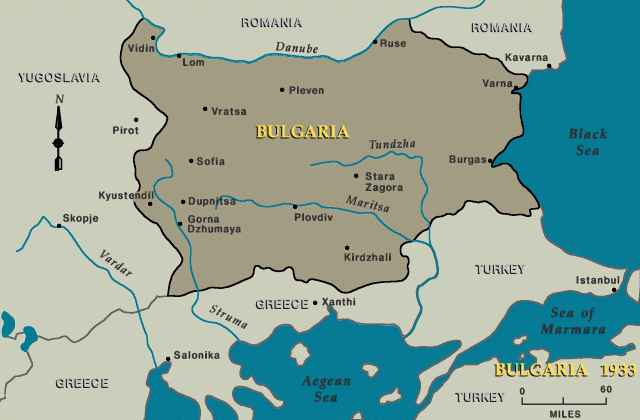
Between 1919 and 1945, Bulgaria was one of several kingdoms located in southeastern Europe, an area often referred to as the Balkans. In 1934, Bulgaria had a population of more than six million people. In that year, Jews constituted 0.8 percent of the total population, or roughly 50,000 individuals.

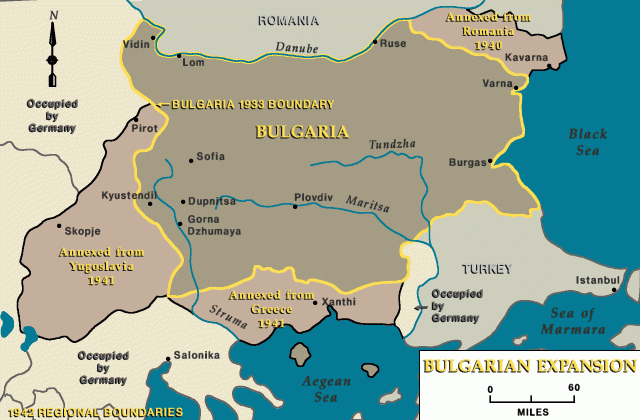
Bulgarian Expansion​

Bulgaria: Maps

89c27963-4613-4238-b77d-c900c633cf33.gif

Bulgaria, 1933
bab138a4-00b4-4f8e-afff-7f606293b032.gif

Bulgaria, border changes 1939-1942
Axis alliance, 1939-1941
Deportations from southern Europe, 1942-1943
Southern Europe, 1945
At the end of World War I, Serbian troops reconquered Macedonia from Bulgaria. Under the provisions of the Treaty of Neuilly, signed in November 1919, the victorious Entente powers confirmed the incorporation of Macedonia into the newly constructed state of Yugoslavia and required Bulgaria to cede Thrace to Greece. The treaty established a limit of 20,000 men under arms permitted in the Bulgarian armed forces. A popularly elected Bulgarian government forced King Ferdinand to abdicate in the autumn of 1918. Ferdinand's son, Boris ascended the throne as Tsar Boris III.


In 1935, Boris established a royal dictatorship. Under various governments since 1923, the Bulgarian regime supported Italian policy in attempting to destabilize Yugoslavia, in the hopes of acquiring Macedonia. After 1935, Boris aligned the country increasingly with Germany in the Nazi aim of destroying the postwar peace treaty system. Boris also removed all restrictions on Bulgaria's armed forces.

In early March 1941, Bulgaria joined the Axis alliance and, in April 1941, participated in the German-led attack on Yugoslavia and Greece. In return, Bulgaria received German authorization to occupy most of Greek Thrace, Yugoslav Macedonia, and Pirot County in eastern Serbia. Though Bulgaria participated in the Balkan Campaign, the provisions of its adherence to the Axis alliance allowed it to opt out of participation in the war against the Soviet Union in June 1941.

Persecution of Jews​

Beginning in July 1940, Bulgarian authorities instituted anti-Jewish legislation that excluded Jews from public service, restricted their choice of places of residence, and restricted their participation in many occupations. The legislation also prohibited marriage between Jews and non-Jews.


Jews from Macedonia board deportation trains

Jews from Bulgarian-occupied Macedonia who were rounded up and assembled in the Tobacco Monopoly transit camp in Skopje prepare to board deportation trains. Skopje, Yugoslavia, March 1943.
  • Central Zionist Archives
During the war, German-allied Bulgaria did not deport Jews from the core provinces of Bulgaria. The Bulgarian authorities did, however, deport Jewish residents from Greek and Yugoslav territories that Bulgaria had occupied in 1941. In March 1943, Bulgarian police and military units rounded up all the Jews in Macedonia, Thrace, and Pirot. Bulgarian officials interned 7,000 Macedonian Jews in a transit camp in Skopje. In Greek Thrace, Bulgarian officials deported about 4,000 Jews to assembly points at Gorna Dzhumaya and Dupnitsa and then handed them over to the Germans. In all, Bulgaria deported over 11,000 Jews to German-held territory. By the end of March 1943, virtually all of them died in the Treblinka killing center in German-occupied Poland.


Deportation of Jews from Bulgarian-occupied Thrace
Jews were deported from Kavala, Seres, and Drama in Bulgarian-occupied Thrace. Some 3,000 Jews were taken to Drama and herded onto trains without food or water for transport to a camp in Gorna Dzumaya. The Jews were probably then taken to the Bulgarian port of Lom on the Danube River, where they boarded ships for Vienna. From there, the Nazis deported them to the Treblinka killing center.
  • Bulgarian Film Archive


In accordance with the Wannsee Conference, German diplomats requested the Bulgarian government in the spring of 1942 to release all Jews in Bulgarian-controlled territory into German custody. The Bulgarian government agreed and took the necessary administrative steps to implement deportations, including the establishment of a Commissariat for Jewish Affairs in the Bulgarian Ministry of the Interior. By winter 1943, the Bulgarian government had arranged with representatives of RSHAoffice IV b 4 (under command of Adolf Eichmann) to deport 20,000 Jews as a first stage. Targeted in these first deportations were the Jewish residents of Bulgarian-occupied Thrace, Macedonia, and Pirot (about 13,000 Jews), and approximately 8,000 Jews from Sofia, the Bulgarian capital.

During the first half of March 1943, Bulgarian military and police authorities carried out the deportation of 11,343 Jews residing in the Bulgarian-occupied territories. Once the Jews were in German custody, German authorities transported them to Treblinka, where virtually all were killed in the gas chambers or shot.

As news of the successful deportations and the imminent deportation of Jews from Sofia reached the capital, opposition politicians, Bulgarian intellectuals, and members of the Bulgarian clergy raised the alarm and began to protest openly against deporting Jews from the core provinces of Bulgaria. Tsar Boris was inclined to go forward with the deportations until Dimitur Pešev, the deputy speaker of the Parliament, a representative from Kustendil, and a prominent member of Boris's own Government Ruling Party, personally intervened and persuaded the tsar to delay the planned deportation. On March 19, 1943, Pešev introduced a resolution in the parliament critical of the deportations and demanding a halt to them. The majority in the Government Ruling Party, undoubtedly with Boris's tacit approval, voted down Pešev's resolution and forced his resignation in late March.

After Pešev's resignation, Bulgarian officials resumed preparations to continue the deportations. The growing wave of public protest, which included an intervention from the Metropolitan of the Bulgarian Orthodox Church, eventually forced Boris to change his mind and cancel the deportations in May 1943.

Shortly thereafter, the Bulgarian government announced the expulsion of 20,000 Jews from Sofia to the provinces. (In 1934, the Jewish population of Sofia was about 25,000, 9 percent of the capital's total population.) Police brutally suppressed popular protests staged by both Jews and non-Jews. Within about two weeks, Bulgarian authorities expelled almost 20,000 Jews, relocated them to the Bulgarian countryside, and deployed males at forced labor in forced-labor camps. Bulgarian authorities also confiscated most of the property left behind by those deported.

Although allied with Nazi Germany, Bulgaria remained neutral in the German-Soviet war and maintained diplomatic relations with the Soviet Union until 1944. As Soviet forces approached in late summer 1944, however, the Soviet Union declared war on Bulgaria. In September, a military coup overthrew the Bulgarian government, a Regency, which had governed the country since King Boris’s sudden death on August 28, 1943, leaving his son Simeon, a six year old, as heir. The military government sued for peace with the Soviet Union, and in October 1944, Bulgaria switched allegiances and declared war on Germany. After the war, Bulgaria, under Communist rule since February 1945, retained the Dobruja region, which it had acquired from Romania in 1940, but had to withdraw from Macedonia, Thrace, and Pirot, returning these provinces to Greek and Yugoslav authority.

In 1945, the Jewish population of Bulgaria was still about 50,000, its prewar level. By 1948, however, more than 35,000 Bulgarian Jews had emigrated to the British Mandate in Palestine, a part of which became the state of Israel in May 1948. Most of the rest had also emigrated from Bulgaria by 1950.

Author(s): United States Holocaust Memorial Museum, Washington, DC

https://encyclopedia.ushmm.org/content/en/article/bulgaria

 
Poslednja izmena:
Царска Бугарска можда није постојала само у твојој неписменој глави.
Наведи пример фашистичке партије у Бугарској? Ко су били њени војни органи и полиција (нпр. Гестапо, Ваффен-СС у Немачкој или Српска државна стража у Србији). Која је владајућа странка у Бугарској? Постоје ли владајуће политичке групе између 1941-1944?
On ne zna da posle drzavnog udara u 19 maja 1934,pa cak do 1945 u Bugarskoj sa ukinuti i zabranjeni svih partije i stranke.Nema fasizam ili nacizam bez vladajuca stranka kao NSDAP u Nemackoj,Falanga u Spaniji ili PNF u Italiji.
The new government abolished the Tarnovo Constitution, dissolved the National Assembly and banned political parties and organizations, revolutionary organizations and trade unions.
https://en.wikipedia.org/wiki/1934_Bulgarian_coup_d'état
 
Бугарски и српски језик припадају једном протословенском дијалекту. До идентификације било каквих јаснијих морфолошких разлика није дошло пре 10. века. Тада су се појавиле прве јужнословенске изоглосе. Узми мапа из 10. века и види која је географска граница између Бугарске и Србије. Старословенски језик сачуван у неким документима из 10. века показује сличност са такозваним источним јужнословенским дијалектом, из којег се касније развио бугарски језик. Распон такозваног прасрпског језика је западно од линије Срем – Џаковица.
По ко зна који пут исправљам твоје фантазмагорије..
Proizvoljna izjava jednog velikobugarina. Srpski i bugarski uopšte ne pripadaju istoj podgrupi, a originalno nisu ni istoj grupi, niti istoj lingivističkoj familiji: onogurski nije ni indoevropski niti može da bude slovenski.

Takozvani “bugarski jezik” sada može da se nađe samo i isključivo među Čuvašima, a u Srbiji samo Bosilegrad govori dijaalektom koji ima izvesne osobine istočne podgrupe južnoslovenskih jezika.
 
On ne zna da posle drzavnog udara u 19 maja 1934,pa cak do 1945 u Bugarskoj sa ukinuti i zabranjeni svih partije i stranke.Nema fasizam ili nacizam bez vladajuca stranka kao NSDAP u Nemackoj,Falanga u Spaniji ili PNF u Italiji.

https://en.wikipedia.org/wiki/1934_Bulgarian_coup_d'état
Svojevoljno i direktno učešće Bugarske države u Holokaustu dokazuje nacističku prorodu režima, šta god vi ovde “dokazivali”

I Boris Treći lično se “zagrejao za projekat”, mada veoma oprezno, pa tek posle slomova Vermahta na Istočnom frontu je rešio da menja ploču.

https://encyclopedia.ushmm.org/content/en/article/bulgaria
 
@Boris T @Nenad1331 @хан Ацо

Učešće nacističkog režima Borisa Trećeg u Holokaustu:


Pogledajte prilog 1372223

Between 1919 and 1945, Bulgaria was one of several kingdoms located in southeastern Europe, an area often referred to as the Balkans. In 1934, Bulgaria had a population of more than six million people. In that year, Jews constituted 0.8 percent of the total population, or roughly 50,000 individuals.

Bulgarian Expansion​

Bulgaria: Maps

89c27963-4613-4238-b77d-c900c633cf33.gif

Bulgaria, 1933
bab138a4-00b4-4f8e-afff-7f606293b032.gif

Bulgaria, border changes 1939-1942
Axis alliance, 1939-1941
Deportations from southern Europe, 1942-1943
Southern Europe, 1945
At the end of World War I, Serbian troops reconquered Macedonia from Bulgaria. Under the provisions of the Treaty of Neuilly, signed in November 1919, the victorious Entente powers confirmed the incorporation of Macedonia into the newly constructed state of Yugoslavia and required Bulgaria to cede Thrace to Greece. The treaty established a limit of 20,000 men under arms permitted in the Bulgarian armed forces. A popularly elected Bulgarian government forced King Ferdinand to abdicate in the autumn of 1918. Ferdinand's son, Boris ascended the throne as Tsar Boris III.


In 1935, Boris established a royal dictatorship. Under various governments since 1923, the Bulgarian regime supported Italian policy in attempting to destabilize Yugoslavia, in the hopes of acquiring Macedonia. After 1935, Boris aligned the country increasingly with Germany in the Nazi aim of destroying the postwar peace treaty system. Boris also removed all restrictions on Bulgaria's armed forces.

In early March 1941, Bulgaria joined the Axis alliance and, in April 1941, participated in the German-led attack on Yugoslavia and Greece. In return, Bulgaria received German authorization to occupy most of Greek Thrace, Yugoslav Macedonia, and Pirot County in eastern Serbia. Though Bulgaria participated in the Balkan Campaign, the provisions of its adherence to the Axis alliance allowed it to opt out of participation in the war against the Soviet Union in June 1941.

Persecution of Jews​

Beginning in July 1940, Bulgarian authorities instituted anti-Jewish legislation that excluded Jews from public service, restricted their choice of places of residence, and restricted their participation in many occupations. The legislation also prohibited marriage between Jews and non-Jews.


Jews from Macedonia board deportation trains

Jews from Bulgarian-occupied Macedonia who were rounded up and assembled in the Tobacco Monopoly transit camp in Skopje prepare to board deportation trains. Skopje, Yugoslavia, March 1943.
  • Central Zionist Archives
During the war, German-allied Bulgaria did not deport Jews from the core provinces of Bulgaria. The Bulgarian authorities did, however, deport Jewish residents from Greek and Yugoslav territories that Bulgaria had occupied in 1941. In March 1943, Bulgarian police and military units rounded up all the Jews in Macedonia, Thrace, and Pirot. Bulgarian officials interned 7,000 Macedonian Jews in a transit camp in Skopje. In Greek Thrace, Bulgarian officials deported about 4,000 Jews to assembly points at Gorna Dzhumaya and Dupnitsa and then handed them over to the Germans. In all, Bulgaria deported over 11,000 Jews to German-held territory. By the end of March 1943, virtually all of them died in the Treblinka killing center in German-occupied Poland.


Deportation of Jews from Bulgarian-occupied Thrace
Jews were deported from Kavala, Seres, and Drama in Bulgarian-occupied Thrace. Some 3,000 Jews were taken to Drama and herded onto trains without food or water for transport to a camp in Gorna Dzumaya. The Jews were probably then taken to the Bulgarian port of Lom on the Danube River, where they boarded ships for Vienna. From there, the Nazis deported them to the Treblinka killing center.
  • Bulgarian Film Archive


In accordance with the Wannsee Conference, German diplomats requested the Bulgarian government in the spring of 1942 to release all Jews in Bulgarian-controlled territory into German custody. The Bulgarian government agreed and took the necessary administrative steps to implement deportations, including the establishment of a Commissariat for Jewish Affairs in the Bulgarian Ministry of the Interior. By winter 1943, the Bulgarian government had arranged with representatives of RSHAoffice IV b 4 (under command of Adolf Eichmann) to deport 20,000 Jews as a first stage. Targeted in these first deportations were the Jewish residents of Bulgarian-occupied Thrace, Macedonia, and Pirot (about 13,000 Jews), and approximately 8,000 Jews from Sofia, the Bulgarian capital.

During the first half of March 1943, Bulgarian military and police authorities carried out the deportation of 11,343 Jews residing in the Bulgarian-occupied territories. Once the Jews were in German custody, German authorities transported them to Treblinka, where virtually all were killed in the gas chambers or shot.

As news of the successful deportations and the imminent deportation of Jews from Sofia reached the capital, opposition politicians, Bulgarian intellectuals, and members of the Bulgarian clergy raised the alarm and began to protest openly against deporting Jews from the core provinces of Bulgaria. Tsar Boris was inclined to go forward with the deportations until Dimitur Pešev, the deputy speaker of the Parliament, a representative from Kustendil, and a prominent member of Boris's own Government Ruling Party, personally intervened and persuaded the tsar to delay the planned deportation. On March 19, 1943, Pešev introduced a resolution in the parliament critical of the deportations and demanding a halt to them. The majority in the Government Ruling Party, undoubtedly with Boris's tacit approval, voted down Pešev's resolution and forced his resignation in late March.

After Pešev's resignation, Bulgarian officials resumed preparations to continue the deportations. The growing wave of public protest, which included an intervention from the Metropolitan of the Bulgarian Orthodox Church, eventually forced Boris to change his mind and cancel the deportations in May 1943.

Shortly thereafter, the Bulgarian government announced the expulsion of 20,000 Jews from Sofia to the provinces. (In 1934, the Jewish population of Sofia was about 25,000, 9 percent of the capital's total population.) Police brutally suppressed popular protests staged by both Jews and non-Jews. Within about two weeks, Bulgarian authorities expelled almost 20,000 Jews, relocated them to the Bulgarian countryside, and deployed males at forced labor in forced-labor camps. Bulgarian authorities also confiscated most of the property left behind by those deported.

Although allied with Nazi Germany, Bulgaria remained neutral in the German-Soviet war and maintained diplomatic relations with the Soviet Union until 1944. As Soviet forces approached in late summer 1944, however, the Soviet Union declared war on Bulgaria. In September, a military coup overthrew the Bulgarian government, a Regency, which had governed the country since King Boris’s sudden death on August 28, 1943, leaving his son Simeon, a six year old, as heir. The military government sued for peace with the Soviet Union, and in October 1944, Bulgaria switched allegiances and declared war on Germany. After the war, Bulgaria, under Communist rule since February 1945, retained the Dobruja region, which it had acquired from Romania in 1940, but had to withdraw from Macedonia, Thrace, and Pirot, returning these provinces to Greek and Yugoslav authority.

In 1945, the Jewish population of Bulgaria was still about 50,000, its prewar level. By 1948, however, more than 35,000 Bulgarian Jews had emigrated to the British Mandate in Palestine, a part of which became the state of Israel in May 1948. Most of the rest had also emigrated from Bulgaria by 1950.

Author(s): United States Holocaust Memorial Museum, Washington, DC

https://encyclopedia.ushmm.org/content/en/article/bulgaria
Nije bilo nacistickog ili fasistickog rezima U Bugarskoj,a Beograd je bio prvi Judenfrei stadt u Evropi.
Uostalom Bugarska je sacuvala svih Jevreja na svojoj teritoriji,da niste okupirali vi i Grcka nasoj Makedoniji bisme sacuvili i tamosnih Jevreja.
The events that prevented the deportation to extermination camps of about 48,000[13] Jews in spring 1943 are termed the "Rescue of the Bulgarian Jews". The survival rate of the Jewish population in Bulgaria as a result was one of the highest in Axis Europe.
https://en.wikipedia.org/wiki/The_Holocaust_in_Bulgaria
 
Nije bilo nacistickog ili fasistickog rezima U Bugarskoj,a Beograd je bio prvi Judenfrei stadt u Evropi.
Uostalom Bugarska je sacuvala svih Jevreja na svojoj teritoriji,da niste okupirali vi i Grcka nasoj Makedoniji bisme sacuvili i tamosnih Jevreja.

https://en.wikipedia.org/wiki/The_Holocaust_in_Bulgaria
Sada vrtiš i ustaške “dokaze” o Srbiji pod okupacijom gde su Nemci hapsili a vi Bugari sami hapsili i izručivali Hitleru.
 
“Rasni zakoni” su u Bugarskoj uvedeni još 1940, i time je bugarska država jasno postala nacistička. Tek kasnije su počele mere za rešavanje problema “rasno nepoželjnog stanovništva”, i ti u režiji bugarske države a ne Nemaca - Bugarska uopšte nije bila okupirana tokom Drugog svetskog rata.

Beginning in July 1940, Bulgarian authorities instituted anti-Jewish legislation that excluded Jews from public service, restricted their choice of places of residence, and restricted their participation in many occupations. The legislation also prohibited marriage between Jews and non-Jews.
The Bulgarian authorities did, however, deport Jewish residents from Greek and Yugoslav territories that Bulgaria had occupied in 1941. In March 1943, Bulgarian police and military units rounded up all the Jews in Macedonia, Thrace, and Pirot. Bulgarian officials interned 7,000 Macedonian Jews in a transit camp in Skopje. In Greek Thrace, Bulgarian officials deported about 4,000 Jews to assembly points at Gorna Dzhumaya and Dupnitsa and then handed them over to the Germans. In all, Bulgaria deported over 11,000 Jews to German-held territory. By the end of March 1943, virtually all of them died in the Treblinka killing center in German-occupied Poland.


In accordance with the Wannsee Conference, German diplomats requested the Bulgarian government in the spring of 1942 to release all Jews in Bulgarian-controlled territory into German custody. The Bulgarian government agreed and took the necessary administrative steps to implement deportations, including the establishment of a Commissariat for Jewish Affairs in the Bulgarian Ministry of the Interior. By winter 1943, the Bulgarian government had arranged with representatives of RSHAoffice IV b 4 (under command of Adolf Eichmann) to deport 20,000 Jews as a first stage. Targeted in these first deportations were the Jewish residents of Bulgarian-occupied Thrace, Macedonia, and Pirot (about 13,000 Jews), and approximately 8,000 Jews from Sofia, the Bulgarian capital.
 
“Rasni zakoni” su u Bugarskoj uvedeni još 1940, i time je bugarska država jasno postala nacistička. Tek kasnije su počele mere za rešavanje problema “rasno nepoželjnog stanovništva”, i ti u režiji bugarske države a ne Nemaca - Bugarska uopšte nije bila okupirana tokom Drugog svetskog rata.

Beginning in July 1940, Bulgarian authorities instituted anti-Jewish legislation that excluded Jews from public service, restricted their choice of places of residence, and restricted their participation in many occupations. The legislation also prohibited marriage between Jews and non-Jews.
The Bulgarian authorities did, however, deport Jewish residents from Greek and Yugoslav territories that Bulgaria had occupied in 1941. In March 1943, Bulgarian police and military units rounded up all the Jews in Macedonia, Thrace, and Pirot. Bulgarian officials interned 7,000 Macedonian Jews in a transit camp in Skopje. In Greek Thrace, Bulgarian officials deported about 4,000 Jews to assembly points at Gorna Dzhumaya and Dupnitsa and then handed them over to the Germans. In all, Bulgaria deported over 11,000 Jews to German-held territory. By the end of March 1943, virtually all of them died in the Treblinka killing center in German-occupied Poland.


Prvi put cujem da je Milan Nedic bio Nemac.Ljoticevci takodje sa bili Nemci?
Ne laži i ne lupetaj.
 
Ишао је јер су Немци због огромних губитака на Источном фронту планирали да део својих посадних јединица из Србије пребаце тамо како би зауставили совјетску офанзиву, а да Бугарима предају део окупиране Србије који су држали.Недић је ишао да моли Хитлера да му дозволи да формира своју војску од 100 000 војника која ће уместо њих у Србији завести ред, знајући за бугарске репресалије и злочине према српском становништву у делу Србије који су Бугари већ окупирали.
Хитлер је рекао да не може, и Бугари су проширили своју окупациону зону у Србији која је од тада долазила скоро до Београда.
 
In 1945, the Jewish population of Bulgaria was still about 50,000, its prewar level. By 1948, however, more than 35,000 Bulgarian Jews had emigrated to the British Mandate in Palestine, a part of which became the state of Israel in May 1948. Most of the rest had also emigrated from Bulgaria by 1950.
Питам се да ли ћеш коментарисати зашто је свих 50 хиљада Јевреја у Бугарској преживело рат? Имаш ли идеју зашто?
Rasni zakoni” su u Bugarskoj uvedeni još 1940, i time je bugarska država jasno postala nacistička. Tek kasnije su počele mere za rešavanje problema “rasno nepoželjnog stanovništva”, i ti u režiji bugarske države a ne Nemaca - Bugarska uopšte nije bila okupirana tokom Drugog svetskog rata.
„Закон о заштити нације" донет је јануара 1941.
Спас бугарских Јевреја је епизода у историји Бугарске током Другог светског рата, када је од 1943. до 1945. године од истребљења спасено око 50 хиљада бугарских Јевреја од стране праведника света и оних који нису били равнодушни.
Међу организаторима спасавања Јевреја били су Димитар Пешев, егзарх бугарски Стефан и митрополит пловдивски Кирил. Убедили су цара Бориса да заустави изручење бугарских Јевреја Немцима. Забрана депортације Јевреја ступила је на снагу 10. марта 1943. године. Чин бугарских власти је надалеко поштован у свету, а посебну захвалност изразио је израелски председник Шимон Перес.
Свића ти се то или не – оно што је горе написано остаје чињеница – светски призната
 
O etničkoj strukturi stanovništva Republike Bugarske:

Bulgarian Turks

Bulgarian Turks (Bulgarian: български турци, romanized: bŭlgarski turtsi; Turkish: Bulgaristan Türkleri) are ethnic Turks from Bulgaria. According to the 2021 census, there were 508,375 Bulgarians of Turkish descent, roughly 8.4% of the population,[1] making them the country's largest ethnic minority. Bulgarian Turks also comprise the largest single population of Turks in the Balkans. They primarily live in the southern province of Kardzhali and the northeastern provinces of Shumen, Silistra, Razgrad and Targovishte. There is also a diaspora outside Bulgaria in countries such as Turkey, Austria, the Netherlands, Sweden, Norway and Romania, the most significant of which are the Bulgarian Turks in Turkey.

Bulgarian Turks are the descendants of Turkishsettlers who entered the region after the Ottoman conquest of the Balkans in the late 14th and early 15th centuries, as well as Bulgarian converts to Islam who became Turkified during the centuries of Ottoman rule.[14][15] However, it has also been suggested that some Turks living today in Bulgaria may be direct ethnic descendants of earlier medieval Pecheneg, Oghuz, and Cuman Turkic tribes.[16][17][18][19] According to local tradition, following a resettlement policy Karamanid Turks (mainly from the Konya Vilayet, Nevşehir Vilayet and Niğde Vilayet of the Karaman Province) were settled mainly in the Kardzhali area by the sultans Mehmed the Conqueror, Selim and Mahmud II.[20] The Turkish community became an ethnic minority when the Principality of Bulgaria was established after the Russo-Turkish War of 1877–78. This community is of Turkish ethnic consciousness and differs from the majority Bulgarian ethnicity and the rest of the Bulgarian nation by its own language, religion, culture, customs, and traditions.

Genetic origins​

See also: Genetic studies on Turkish people
DNA research investigating the three largest population groups in Bulgaria: Bulgarians, Turks and Roma confirms with Y-chromosomal analysis on STR that there are significant differences between the three ethnic groups. The study revealed a high number of population-specific haplotypes, 54 haplotypes among 63 tested Turkish males from the Bulgarian DNA bank and fathers from routine paternity cases born in various geographical regions of Bulgaria.[21] The haplotypes of the Turks from Bulgaria as converted to haplogroups make up the following frequencies: J2 (18%), I2 (13%), E (13%), H(11%), R1a (10%), R1b (8%), I1 (6%), J1 (6%), G(6%), N (5%), Q (3%).[22]

A Y-DNA genetic study on Slavic peoples and some of their neighbours published two statistical distributions of distance because of the volume of details studied, based on pairwise FST values, the Turks from Bulgaria are most related to Anatolian Turks, thereafter to Italians, Bulgarians and others]; while according to the RST values, the Turks from Bulgaria are most related to Bulgarians, thereafter to Macedonians, Anatolian Turks, Serbs and the rest, while Balts and North Slavsremain most unrelated according to them both. The study claims that the FST genetic distances reflect interpopulation relationships between the compared populations much better than their stepwise-based analogues, but that at the same time the genetic variation was more profoundly calculated by RST.[23] FSTand RST calculate allele (haplotype or microsatellite) frequencies among populations and the distribution of evolutionary distances among alleles. RST is based on the number of repeat differences between alleles at each microsatellite locus and is proposed to be better for most typical sample sizes, when data consist of variation at microsatellite loci or of nucleotide sequence (haplotype) information, the method may be unreliable unless a large number of loci are used. A nonsignificant test suggests that FST should be preferred or when there is high gene flow within populations, FSTcalculations are based on allele identity, it is likely to perform better than counterparts based on allele size information, the method depends on mutation rate, sometimes can likely provide biased estimate, but RST will not perform necessarily better. A Bulgarian and other population studies observed concluded that when there is not much differentiation, both statistical means show similar results, otherwise RST is often superior to the FST. However, no procedure has been developed to date for testing whether single-locus RST and FST estimates are significantly different.[24][25]
 
O etničkoj strukturi stanovništva Republike Bugarske:

Bulgarian Turks

Bulgarian Turks (Bulgarian: български турци, romanized: bŭlgarski turtsi; Turkish: Bulgaristan Türkleri) are ethnic Turks from Bulgaria. According to the 2021 census, there were 508,375 Bulgarians of Turkish descent, roughly 8.4% of the population,[1] making them the country's largest ethnic minority. Bulgarian Turks also comprise the largest single population of Turks in the Balkans. They primarily live in the southern province of Kardzhali and the northeastern provinces of Shumen, Silistra, Razgrad and Targovishte. There is also a diaspora outside Bulgaria in countries such as Turkey, Austria, the Netherlands, Sweden, Norway and Romania, the most significant of which are the Bulgarian Turks in Turkey.

Bulgarian Turks are the descendants of Turkishsettlers who entered the region after the Ottoman conquest of the Balkans in the late 14th and early 15th centuries, as well as Bulgarian converts to Islam who became Turkified during the centuries of Ottoman rule.[14][15] However, it has also been suggested that some Turks living today in Bulgaria may be direct ethnic descendants of earlier medieval Pecheneg, Oghuz, and Cuman Turkic tribes.[16][17][18][19] According to local tradition, following a resettlement policy Karamanid Turks (mainly from the Konya Vilayet, Nevşehir Vilayet and Niğde Vilayet of the Karaman Province) were settled mainly in the Kardzhali area by the sultans Mehmed the Conqueror, Selim and Mahmud II.[20] The Turkish community became an ethnic minority when the Principality of Bulgaria was established after the Russo-Turkish War of 1877–78. This community is of Turkish ethnic consciousness and differs from the majority Bulgarian ethnicity and the rest of the Bulgarian nation by its own language, religion, culture, customs, and traditions.

Genetic origins​

See also: Genetic studies on Turkish people
DNA research investigating the three largest population groups in Bulgaria: Bulgarians, Turks and Roma confirms with Y-chromosomal analysis on STR that there are significant differences between the three ethnic groups. The study revealed a high number of population-specific haplotypes, 54 haplotypes among 63 tested Turkish males from the Bulgarian DNA bank and fathers from routine paternity cases born in various geographical regions of Bulgaria.[21] The haplotypes of the Turks from Bulgaria as converted to haplogroups make up the following frequencies: J2 (18%), I2 (13%), E (13%), H(11%), R1a (10%), R1b (8%), I1 (6%), J1 (6%), G(6%), N (5%), Q (3%).[22]

A Y-DNA genetic study on Slavic peoples and some of their neighbours published two statistical distributions of distance because of the volume of details studied, based on pairwise FST values, the Turks from Bulgaria are most related to Anatolian Turks, thereafter to Italians, Bulgarians and others]; while according to the RST values, the Turks from Bulgaria are most related to Bulgarians, thereafter to Macedonians, Anatolian Turks, Serbs and the rest, while Balts and North Slavsremain most unrelated according to them both. The study claims that the FST genetic distances reflect interpopulation relationships between the compared populations much better than their stepwise-based analogues, but that at the same time the genetic variation was more profoundly calculated by RST.[23] FSTand RST calculate allele (haplotype or microsatellite) frequencies among populations and the distribution of evolutionary distances among alleles. RST is based on the number of repeat differences between alleles at each microsatellite locus and is proposed to be better for most typical sample sizes, when data consist of variation at microsatellite loci or of nucleotide sequence (haplotype) information, the method may be unreliable unless a large number of loci are used. A nonsignificant test suggests that FST should be preferred or when there is high gene flow within populations, FSTcalculations are based on allele identity, it is likely to perform better than counterparts based on allele size information, the method depends on mutation rate, sometimes can likely provide biased estimate, but RST will not perform necessarily better. A Bulgarian and other population studies observed concluded that when there is not much differentiation, both statistical means show similar results, otherwise RST is often superior to the FST. However, no procedure has been developed to date for testing whether single-locus RST and FST estimates are significantly different.[24][25]
@хан Ацо
Чему смејање? Хоћеш да кажеш да је измишљено?
 

Back
Top